Wednesday, October 27, 2010

Wednesday, 27 October and Friday, 29 October, 2010


Print these sheets out and use to make up the lab on Tornado Movement.

Students will be able to:
use information from hands-on activities, videos from the internet and classroom discussion to
-identify the role of models in the context of the sixth grade science benchmarks.
-discuss, compare, and negotiate methods used, results obtained, and explanations among
groups of students conducting the same investigation.
-investigate how natural disasters have affected human life in Florida.

Students first watched a portion of a video from Storm Chasers about tornadoes. They answered questions such as what is the difference between a tornado and a hurricane? How does a tornado form?

Students received their lab sheets. They made models of tornados in a bottle and used them to show how tornados form and move.

Absent students should go to the following site and paste the URL address into the URL box. Then, manipulate the width and core pressure to guess the type of tornado produced. Be sure to record data. You can use the individual investigation sheets to write up the lab. (See top of blog)

http://whyfiles.org/013tornado/3.html

On Friday (no class on Thursday, due to early release), students debriefed the mini-assessment in science. They then completed the laboratory write-up. Students also finished gathering the weather data.

Tuesday, October 26, 2010

Tuesday, 26 October, 2010


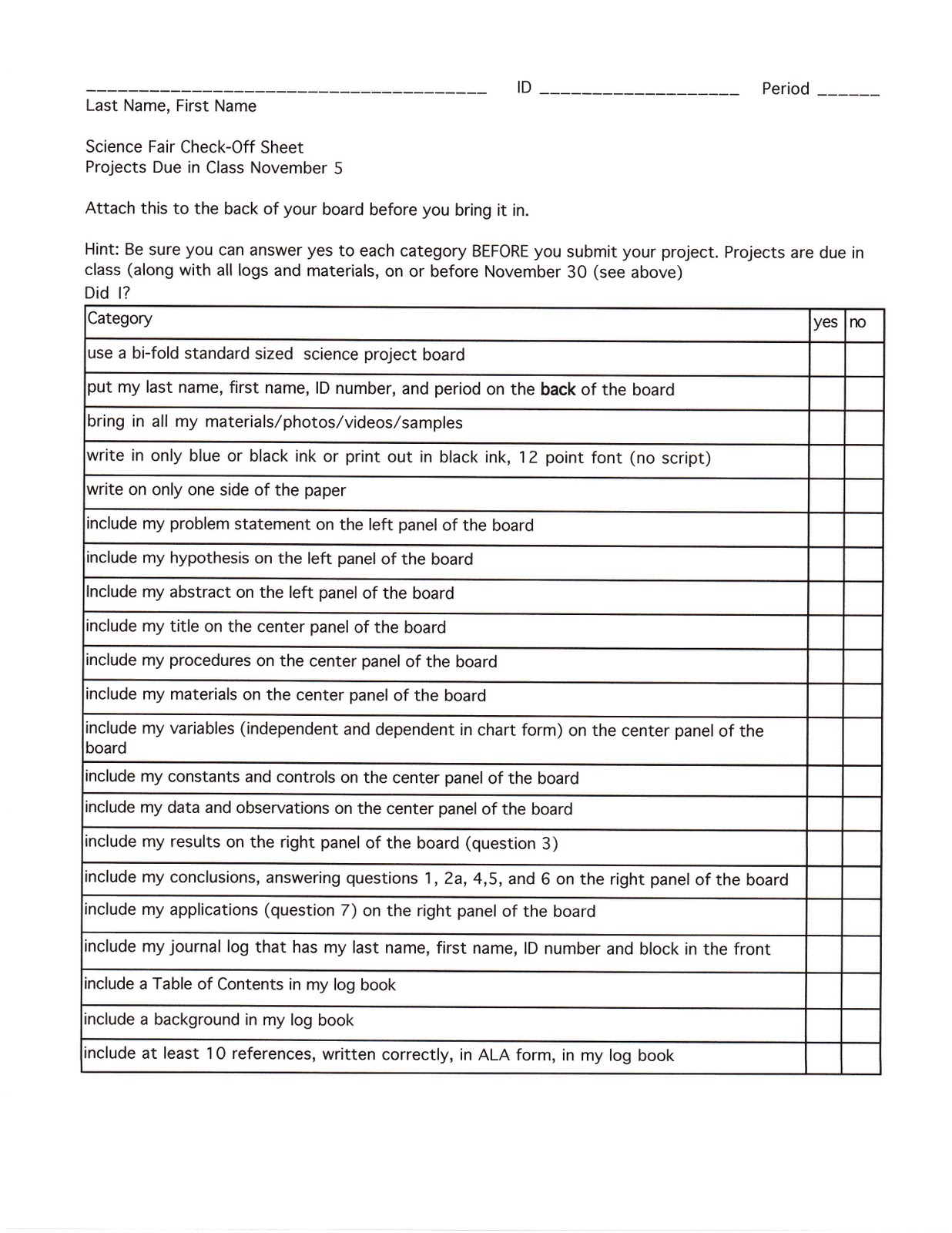
Place this check off sheet on the back of your science board.

Students will be able to:
use information from videos from the internet, textbooks, and classroom discussions to
-measure wind speed and direction using an anemometer.
-observe and record the cloud type and sky coverage.
-measure relative humidity.
-update science fair information.

Students took the mini assessment.

Students reviewed for the science fair. For those that have misplaced handouts, you can find the information at the top of this blog.

Students then used their text books, pages 91-92, to make two column notes on reflection, refraction, and diffraction, listing definitions and examples of each. Students then drew a representation of the term, complete with definition.

Monday, October 25, 2010

Monday, 25 October, 2010

Students will be able to:
use information from hands-on activities, videos from the internet and classroom discussion to
-measure wind speed and direction using an anemometer.
-observe and record the cloud type and sky coverage.
-measure relative humidity.

The do now was another problem from Mastering the FCAT.

Students took Exam 2 using the clickers.

Students then made measurements of temperature, relative humidity, wind speed and direction, sky cover, and precipitation for their weather project.

For home learning, look up information on local weather.

Friday, October 22, 2010

Friday, 22 October, 2010


Remember to bring these with you to class on Monday!

Students will be able to:
use information from hands-on activities and classroom discussion to
-measure wind speed and direction using an anemometer.

The do now was a question from the Mastering the FCAT series.

Students received the question set for Exam 2, which can be found at the top of this blog.

Students also received project papers to measure the weather. Students learned to use tools such as the thermometer, an anemometer, a barometer and a sling psychrometer to measure weather properties.

Monday, October 18, 2010

Monday, 18 October through Thursday, 21 October, 2010


This is HL 18. Answers only on correctly headed paper.


This is HL 17. Answers only on correctly headed loose leaf notebook paper.


This is HL 16. Answers only on correctly headed loose leaf notebook paper.


These are the sheets for HL 15. Show your work on correctly headed loose leaf notebook paper.


These are the handouts for the virtual lab on predicting the weather. Use blue/black ink or pencil to complete.

Students will be able to:
use information from videos from the internet, virtual laboratories, and classroom discussion to
-use station models to forecast conditions for weather stations in a region of the continental United States.

The do now on Monday was a quiz on Spheres of the Earth
The do now on Tuesday was to review the mini assessment.
The do now on Thursday was to answer a Mastering the FCAT question.

On Monday, students watched BrainPop videos on climate and weather.

They received HL #15 on Monday.
They received HL #16 on Tuesday.
They received HL #17 on Wednesday.
They received HL #18 on Thursday.

All HL can be found at the top of this blog.

Students worked on the virtual lab Predicting the Weather. Those pages are also at the top of this blog. Find the link to the lab at Dr. Gayden's Science Zone (drgcdms.podomatic.com).

Friday, October 15, 2010

Friday, 15 October, 2010


Students will be able to:
use information from textbooks and classroom discussion to
-differentiate between weather and climate.

The do now was a quick write: What is the difference between weather and climate?

Students received HL 14, which can be found at the top of this blog.

Students began the virtual lab on weather, found at the Glencoe site, or by clicking the link through Dr. Gayden's Science Zone. Handouts will be distributed on Monday. We will complete the activity on Monday.

Thursday, October 14, 2010

Thursday, 14 October, 2010

Students will be able to:
use information from virtual laboratory experiments and classroom discussions to
-trace the path of a drop of water through the water cycle.
-explain how water evaporates from Earth's surface, condenses into clouds, and then precipitates back to Earth's surface.
-describe the different paths that water can travel on Earth's surface.
-compare the amounts of water in different r reservoirs (oceans, ice, soil, etc.)

The do now was a quick write: How would the earth be different if water vapor were not trapped in the atmosphere but could leave the atmosphere.

Students submitted and reviewed HL #13.

Students spent the remainder of the period finishing the Water Cycle lab.

There was no home learning assignment.